
Updated October 2026
Key facts
- Offshore PPE is chosen by risk assessment. There is no single "offshore norm" for clothing or boots; each hazard has its own standard.
- Flame and heat: EN ISO 11612. Static in explosive atmospheres: EN 1149-5. Electric arc: IEC 61482-2. Light chemical splash: EN 13034 Type 6. Welding spatter: EN ISO 11611.
- Multi-norm coveralls combine several of these in one garment, for example the Dapro Diamond coverall and the Dapro Rope Access coverall.
- Safety boots: EN ISO 20345. S3 means a 200 J toe cap, water-resistant upper and puncture-resistant midsole; HRO means a heat-resistant outsole (300 °C contact).
- High visibility: EN ISO 20471, Class 1 to 3. Always check the label of the individual garment.
Working offshore, whether on oil rigs, wind farms, or marine vessels, requires strict adherence to safety standards. The environment can be harsh and unpredictable, making personal protective equipment (PPE) crucial for worker safety. Specialized safety clothing, shoes, and equipment are designed to protect workers from hazardous conditions such as extreme weather, heavy machinery, and the risk of falling overboard.
Key Safety Clothing for Offshore Work
-
Flame-Resistant Clothing (FRC)
Offshore workers are often exposed to flammable substances. Flame retardant clothing provides essential protection against fire hazards. Made from special fabrics, these garments are designed to resist ignition, self-extinguish, and minimize burn injuries. In oil and gas, FR clothing is commonly required by site rules and the employer's risk assessment. Look for EN ISO 11612; where static or electric arc are also a risk, choose multi-norm clothing that adds EN 1149-5 and IEC 61482-2. -
Thermal and Waterproof Gear
Offshore work often involves exposure to harsh weather conditions, including cold temperatures, high winds, and water. Workers wear thermal clothing to protect against cold stress and waterproof outer layers to stay dry in wet environments. Offshore wind farms and marine vessels often require full immersion suits in case of emergencies. -
High-Visibility Clothing
High-visibility clothing (hi-vis clothing) is essential to ensure workers can be easily seen, especially in low-light or high-traffic areas. Hi-vis safety vests, jackets, or coveralls are commonly worn to improve visibility and reduce the risk of accidents involving heavy equipment or vehicles. Certified hi-vis garments are tested to EN ISO 20471.
Offshore Norms Explained in Plain Words
| Norm | What it covers | What the codes mean |
|---|---|---|
| EN ISO 11612 | Clothing that protects against heat and flame. | A1 = limited flame spread (surface ignition). B = convective heat (B1–B3), C = radiant heat (C1–C4), D = molten aluminium splash, E = molten iron splash (E1–E3), F = contact heat (F1–F3). A higher number means better performance for that letter only. It does not cover electric arc, static or chemicals. |
| EN ISO 11611 | Clothing for welding and allied processes. | Protects against small spatter of molten metal, short flame contact and radiant heat from the welding arc. Class 1 = lighter spatter and lower-risk welding; Class 2 = heavier spatter. |
| EN 1149-5 | Electrostatic dissipative (anti-static) clothing. | Helps prevent sparks from static discharge in explosive atmospheres. It only works as part of an earthed system (for example with antistatic or ESD footwear) and does not protect against live electrical voltage. |
| IEC 61482-2 | Clothing against the thermal effects of an electric arc. | Class 1 (box test) = tested against a 4 kA arc lasting 0.5 s; Class 2 = 7 kA. It covers the heat of an arc flash, not electric shock. |
| EN 13034 Type 6 | Limited protection against liquid chemicals. | For light spray, liquid aerosols or low-pressure, low-volume splashes. It is not a full chemical barrier. |
| EN ISO 14116 | Limited flame spread of materials. | Index 1 (lowest) to Index 3 (highest). Index 3 also requires no hole formation and an afterflame of at most 2 seconds. Index 3 is declared on the Dapro Rope Access coverall. |
| EN ISO 20471 | High-visibility warning clothing. | Class 1, 2 or 3, based on the minimum area of fluorescent and retroreflective material. Class 3 has the most and must cover the torso plus sleeves and/or legs. |
| EN ISO 20345 S3 | Safety footwear. | Toe cap tested to 200 J impact and 15 kN compression, closed heel, antistatic, energy-absorbing heel, water-resistant upper, puncture-resistant midsole and cleated outsole. |
| SRC / SR | Slip resistance of the sole. | SRC is the 2011 marking (tested on ceramic tile and steel). Footwear certified to the 2022 edition uses SR. |
| HRO | Heat-resistant outsole. | The outsole withstands contact with a 300 °C surface for 60 seconds. |
| ESD | Electrostatic dissipative footwear. | Stricter control of static charge than standard antistatic footwear. It is tested under the EN 61340 series, separately from EN ISO 20345. |
Regulatory context: in the UK, the Personal Protective Equipment at Work Regulations require employers to assess risks and provide suitable PPE free of charge, with training. In Norway, NORSOK S-002 sets working-environment requirements for the design of offshore facilities; it is not a PPE product standard. Your employer's or operator's site rules always decide which norms are required.
Certified Offshore Coveralls
- Dapro Diamond coverall: EN ISO 11612:2015 A1 B1 C1 E1 F1, EN 1149-5:2008, EN 13034:2005+A1:2009 Type 6, EN ISO 11611:2007 A1 Class 1 and IEC 61482-2:2009 Class 1, with reflective striping.
- Dapro Rope Access coverall: EN ISO 11612:2015 A1 B1 C1 E1 F1, EN ISO 14116:2015 Index 3, EN 1149-5:2008, EN ISO 11611:2007 A1 Class 1, EN 13034:2005+A1:2009 Type 6 and IEC 61482-2:2009 Class 1. Designed for work with a rope access harness.
See all multi-norm clothing and arc flash protective clothing.
Safety Shoes for Offshore Workers
-
Safety-Toe Boots (Steel or Composite)
Offshore environments involve heavy machinery and moving equipment, making safety-toe boots a necessity. Safety boots with a steel toe or a composite (non-metallic) toe protect the feet from falling objects and crushing injuries, providing both safety and durability. -
Slip-Resistant Soles
Offshore surfaces can be slippery due to oil, water, or debris. Slip-resistant soles are crucial for preventing falls and ensuring workers maintain their footing in hazardous conditions. Look for the SRC or SR marking. -
Waterproof and Insulated Boots
Workers in wet and cold environments need waterproof boots with insulation to keep their feet dry and warm. Offshore wind farms, oil platforms, and marine vessels often require this level of protection, especially in rough seas or stormy weather.
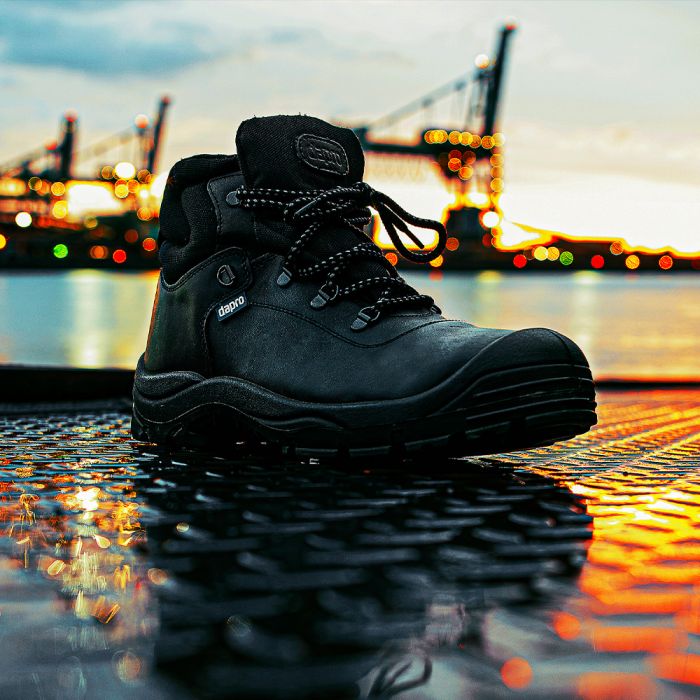
Offshore boots in our range, with the certification stated by the manufacturer:
- Red Wing PetroKing XT 3234: EN ISO 20345:2011 S3 SRC HRO ESD and ASTM F2413-18; non-metallic toe protection, puncture-resistant midsole.
- Red Wing PetroKing LT 3221: S3 to EN ISO 20345:2011, HRO heat resistance up to 300 °C contact heat.
- Red Wing PetroKing LT 3207: S3 safety boot with a nylon composite safety toe cap and side zip.
- Dapro Driller C S3 C: EN ISO 20345:2022 S3S FO SR HRO SC and EN 61340-5-1:2016 ESD; composite toe, heat-resistant sole up to 300 °C.
- Dapro Offshore C S3 C: EN ISO 20345:2011 S3 SRC; composite toe, textile anti-perforation midsole, nitrile sole (300 °C).
See all offshore safety shoes.
Critical PPE for Offshore Safety
-
Hard Hats
Offshore workers face the risk of head injuries from falling objects or bumps in confined spaces. Hard hats are typically required in all active areas to protect against impacts, with chin straps added to ensure the hat stays securely in place. -
Safety Goggles or Face Shields
Eye protection is essential when working around chemicals, debris, or equipment that can project harmful particles. Safety goggles shield the eyes, while face shields offer additional protection for the entire face when working with high-risk materials. -
Hearing Protection
Offshore facilities can be extremely noisy, especially around heavy machinery and drilling equipment. Earplugs or earmuffs help reduce exposure to loud noise, preventing hearing damage over time. -
Respiratory Protection
Depending on the task, workers may be exposed to hazardous fumes, gases, or dust. Respirators or masks protect the lungs from inhaling harmful substances, ensuring workers' respiratory health is maintained. -
Fall Protection
Working at heights is common on offshore rigs and platforms. Fall protection gear, such as harnesses and lanyards, is critical to prevent serious injury. Workers are often connected to safety lines to minimize the risk of falling from elevated structures. -
Gloves
Hands are often exposed to sharp tools, chemicals, and hot surfaces. Protective gloves—whether chemical-resistant, heat-resistant, or cut-resistant—are vital for preventing injuries to the hands.
Frequently Asked Questions
Which norm does flame-resistant offshore clothing need?
The basic norm for heat and flame is EN ISO 11612. Offshore, site rules often also ask for anti-static protection (EN 1149-5) and arc flash protection (IEC 61482-2). Multi-norm coveralls such as the Dapro Diamond combine these in one garment.
What is the difference between EN ISO 11612 and IEC 61482-2?
EN ISO 11612 tests protection against flame, heat and molten metal. IEC 61482-2 tests protection against the heat of an electric arc. A garment certified only to EN ISO 11612 is not automatically arc-flash protective.
What do S3, SRC and HRO mean on offshore safety boots?
S3 (EN ISO 20345) means a 200 J toe cap, water-resistant upper and puncture-resistant midsole. SRC means the sole passed slip tests on ceramic tile and steel (2011 edition; SR in the 2022 edition). HRO means the outsole resists 300 °C contact heat for 60 seconds.
Is anti-static clothing enough on its own?
No. EN 1149-5 clothing only dissipates static charge as part of an earthed system, so it should be worn with antistatic or ESD safety footwear. It does not protect against live electrical voltage.
Conclusion
Safety clothing, shoes, and PPE are non-negotiable requirements for working offshore. From flame-resistant clothing and safety-toe boots to hard hats and harnesses, these items ensure that workers remain protected from the hazardous conditions that are common in offshore environments. By wearing the proper gear, and checking that each item carries the norm your site requires, offshore workers can perform their duties with confidence and significantly reduce the risk of injury or accidents.